
The exhibition season opens on 24 June with “God Year”, the solo exhibition by Paolo Canevari, presented on the first floor of the Palazzina. On 16 July, the spotlight will turn to Marino Marini, one of the great artists of the 20th century, with a selection of bronze sculptures presented under the title “No Heroes”.
From that date onwards, Marino’s works will enter into dialogue with those of Canevari, within an installation characterised by a strong dramatic intensity, while in September the third act of the exhibition will come to life. This will be a site-specific intervention by Norwegian artist Per Barclay, titled “Oscuro Abbagliante”. Once again, Marino’s sculptures will be placed in relation to Barclay’s work.
The exhibition journey will be completed by a sound installation by Friedrich Andreoni, positioned on the bastion overlooking Florence and conceived to accompany visitors throughout their experience of the exhibition.
God Year
Among the most internationally recognised Italian artists, Canevari is known for his use of different materials and media, including drawing, video, sculpture, installation, and performance. Within his interdisciplinary practice, he employs everyday objects and widely recognisable symbols to comment on—and often deconstruct and critique—ideologies, religious beliefs, political narratives, and the great myths of progress and social happiness.
Raised in close contact with the practices of contemporary avant-gardes (Arte Povera, conceptual art, and performance art), and educated in sculpture within his family environment, Canevari has always been able to reinterpret classical and Renaissance art, as well as modern and modernist traditions, through a renewed perspective. This distinctive ability has allowed the artist to navigate the international art world with both theoretical and practical intelligence.
Canevari’s work confronts viewers with the harshest and most tragic aspects of reality, conveying the fratricidal violence of our time without resorting to the rhetoric often found in the media, which can at times contribute to distorted representations of facts and images, as well as manipulations of meaning through language. His works reveal, with lightness and irony, the cynicism of the Economy and Capital, the destructive and oppressive nature of Power, and the homogenising force of every Ideology, presenting the artwork as a material, anxious, and unsettling object.
For Canevari, the image has a complex function: it is never reduced to mere information or a simple caption. Rather, it becomes a poetic and iconic tool for awareness and cognitive growth. From an iconic and symbolic perspective, the image is always treated and activated as an open experience, capable of generating multiple meanings.
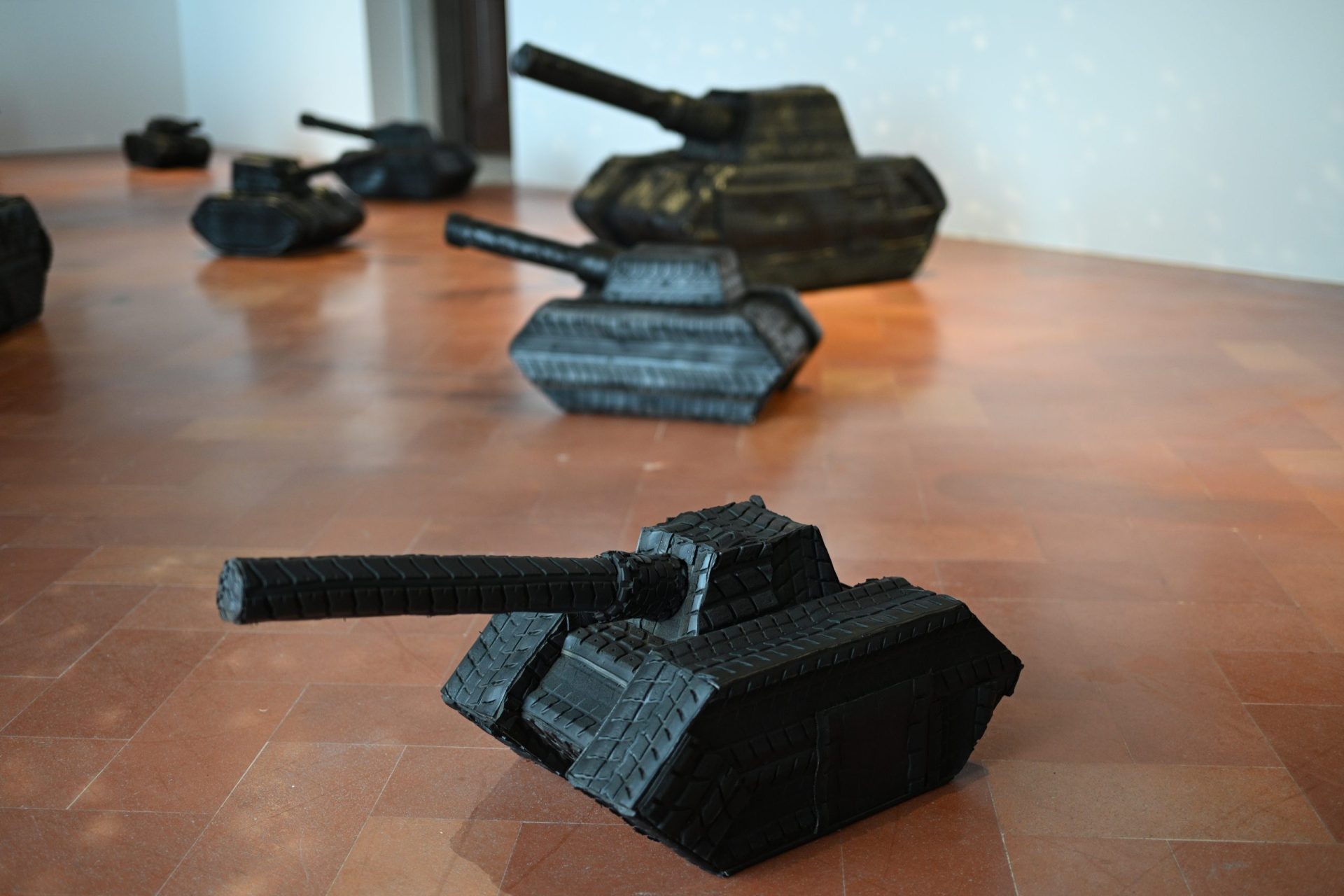
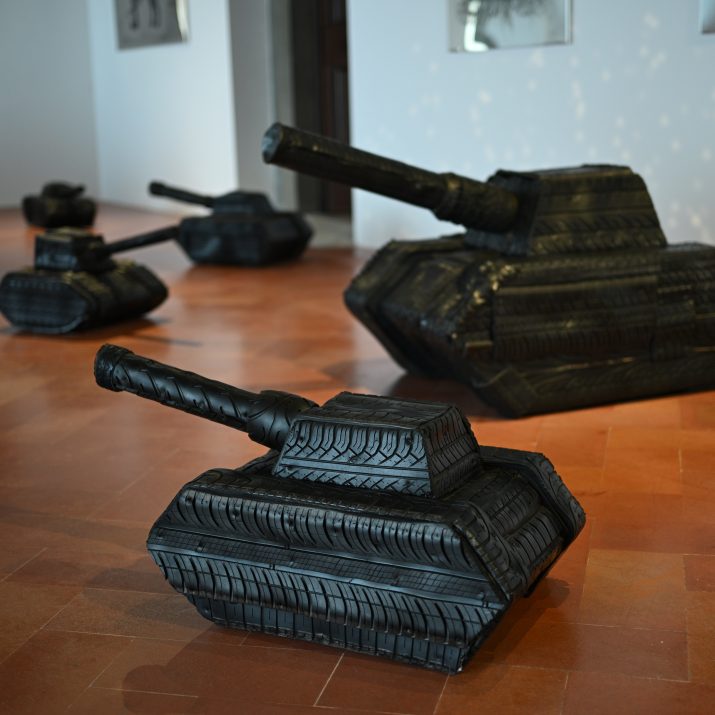
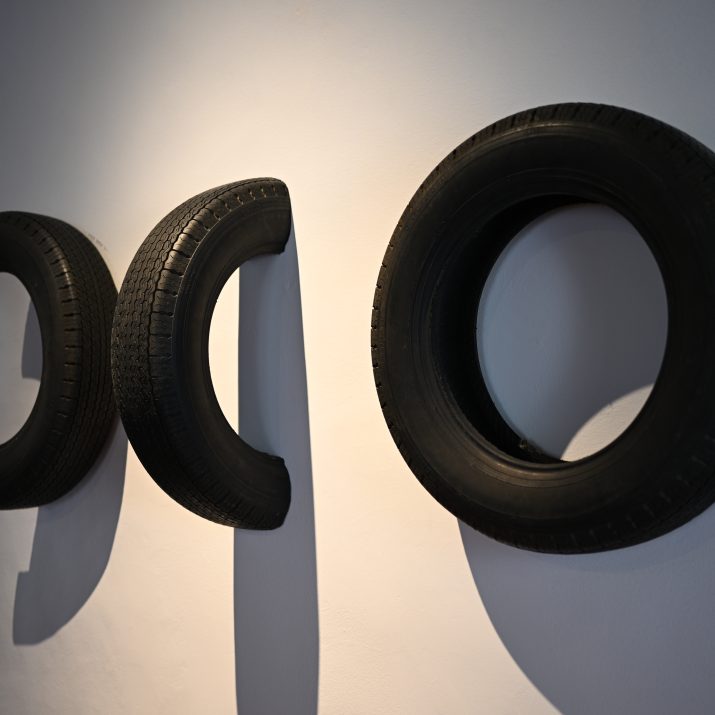
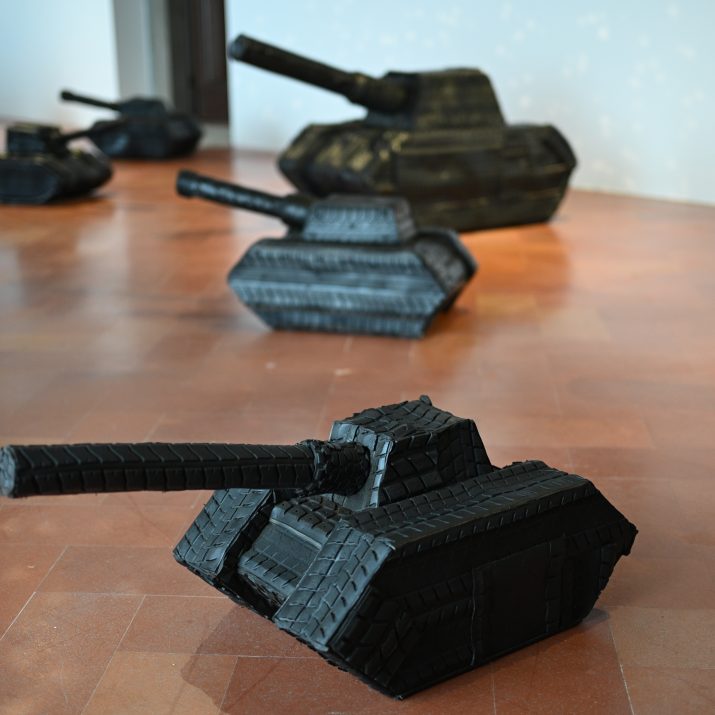
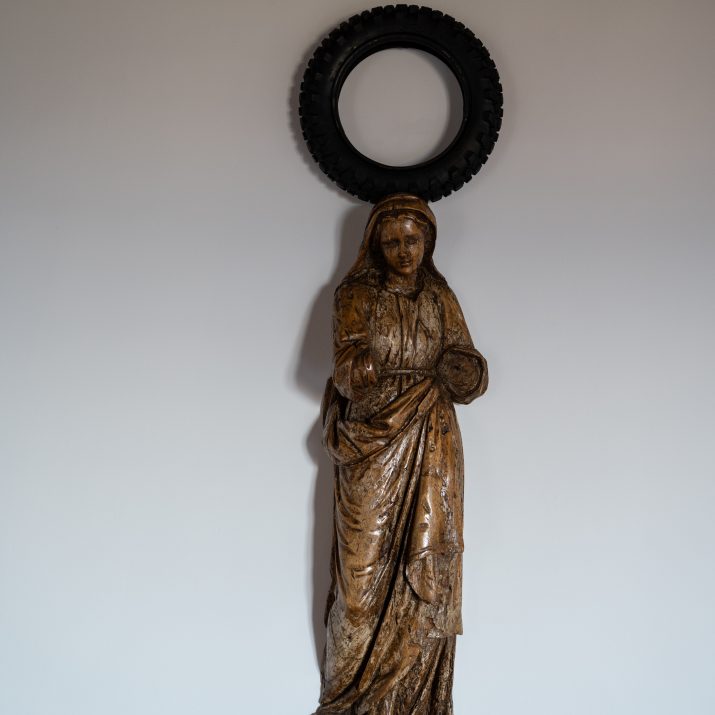
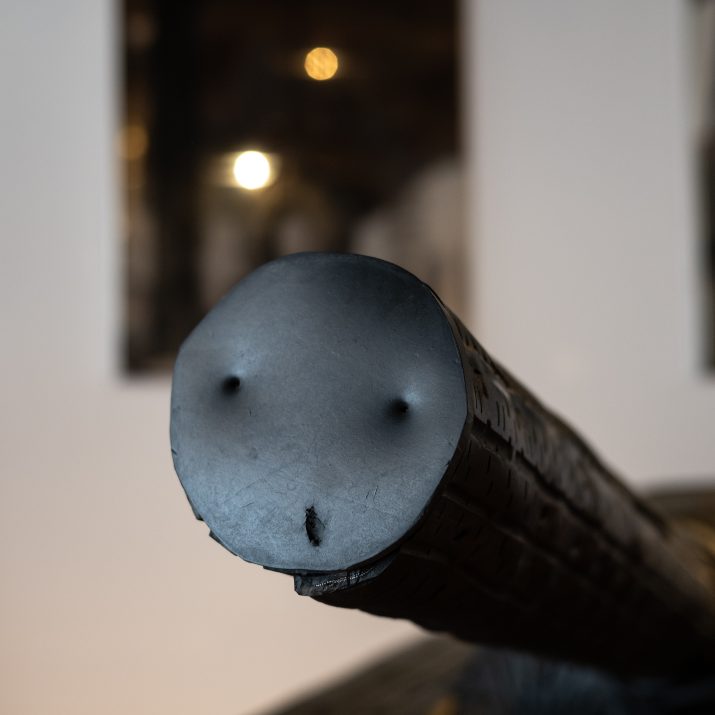
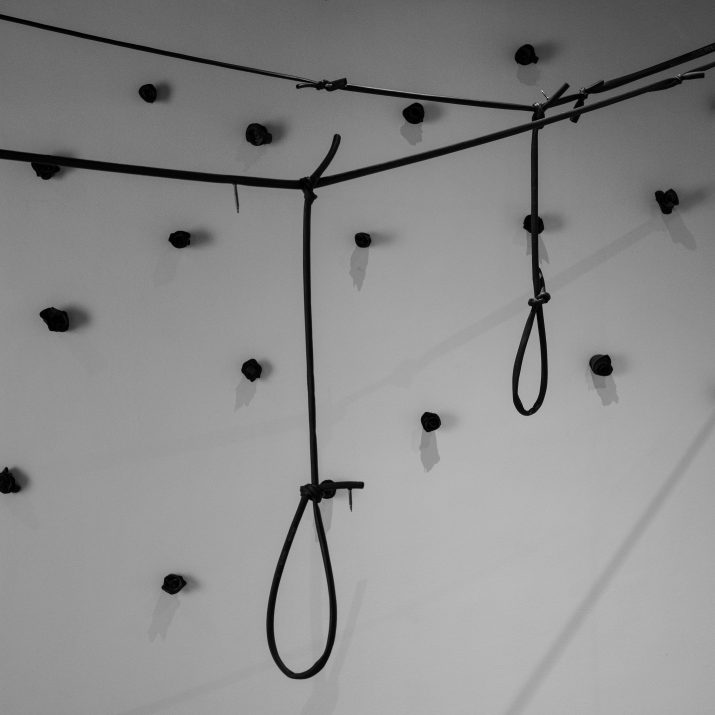
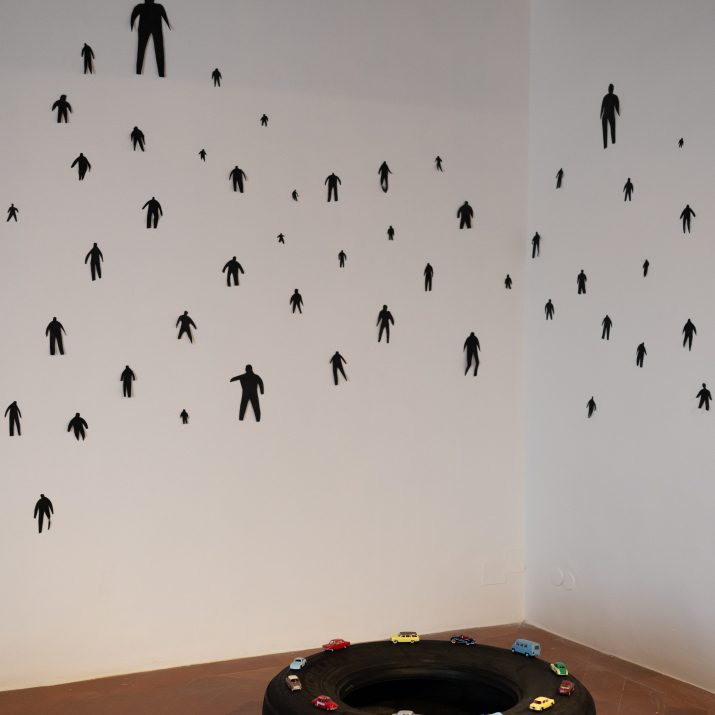
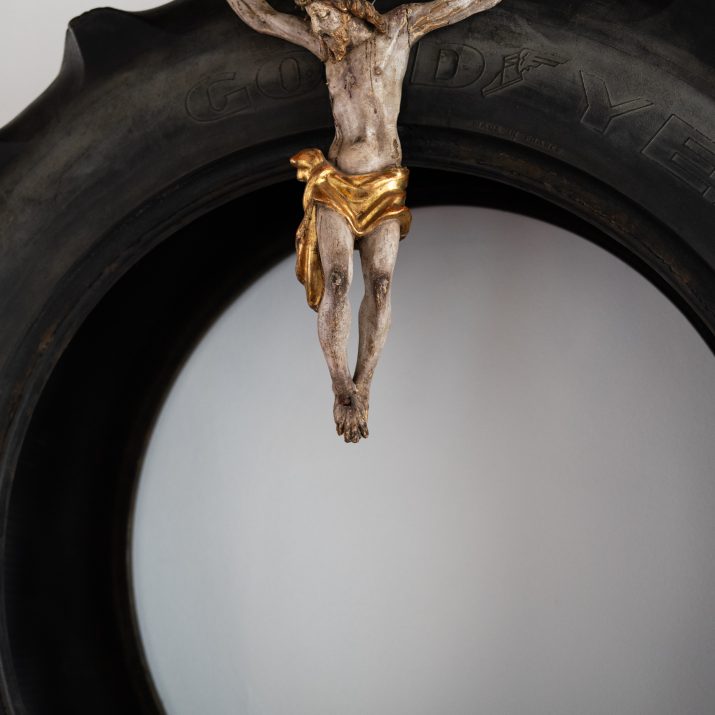
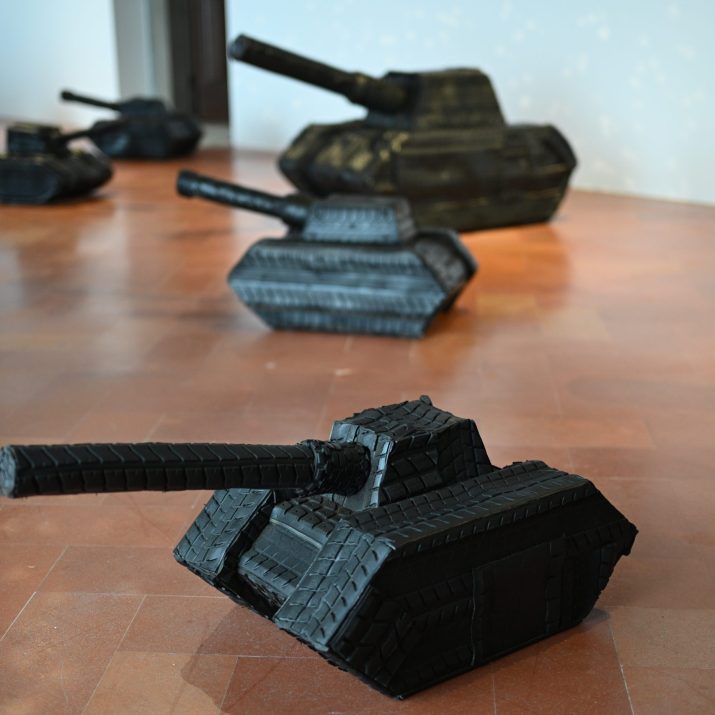
A Rolls-Royce is tattooed with the words “HO FAME” (“I AM HUNGRY”); a child plays football with a skull among the ruins of bombed buildings; small and large tanks made from the “skin” of tyres transform play into an image of war, and vice versa. A wooden figure of the Virgin Mary holds a tyre on her head as if it were a halo; nooses made from inner tubes evoke images of sacrifice and condemnation; a man—the artist himself—dressed elegantly in black welcomes a falling bomb from the sky with open arms. A cut tyre is used to form the word Dio (God) on a wall, combining the materialistic dimension of industrial civilisation with the spiritual one, and juxtaposing horizontal movement (the car) with vertical transcendence (theology).
Canevari frequently works on the ambiguity of signs, materials, and forms, transforming familiar images into unsettling presences, into critical and deconstructive devices. His research emerges from the tension between the language of art and the language of reality, between aesthetics and politics, bringing into dialogue—and often into conflict—cultural symbols, emblems of power, references to political and religious history, collective myths, stereotypes and commonplaces, as well as objects from everyday life.
Through these oppositions, Canevari constructs a tragic vision of contemporary existence, in which every symbol can reveal its darker side and every image can become charged with contradictory and universal meanings.
The reflection on violence, memory, and the mechanisms of control, separation, and censorship that permeate contemporary society lies at the centre of his practice. These themes are explored through the use of humble and industrial materials, such as tyre rubber, which becomes a metaphor for social conditions and for the dangers arising from the exploitation of energy resources.
Oil, its derivatives, and the automotive industry are placed under scrutiny. Black gold remains one of the most powerful instruments of geopolitical dominance, a measure of wealth and global influence. A resource still essential to progress today, oil is also an element capable of triggering wars and financial crises.
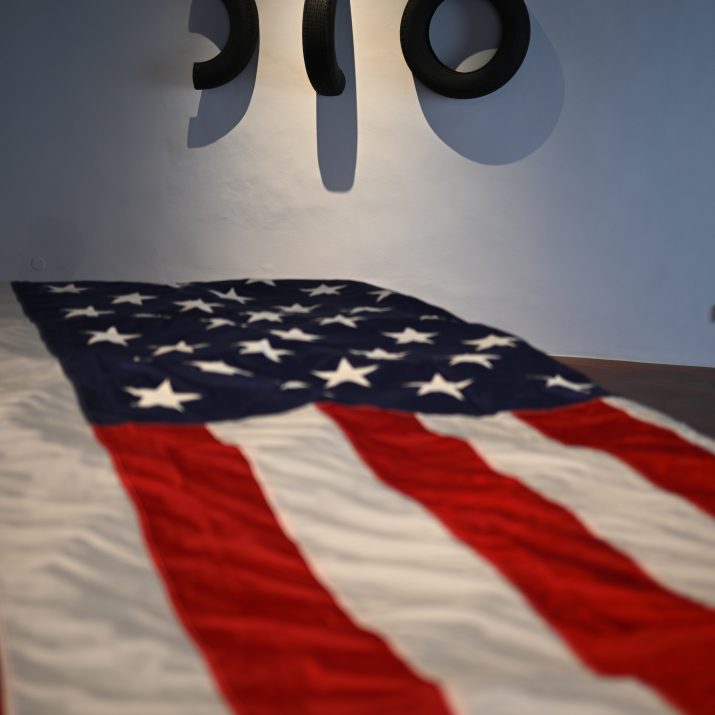
A particularly significant example is the work “Landscape”: an American flag covers a pile of barrels and tyres, which appear like a coffin. It is a powerful and iconic reflection on the close relationship between the oily compound and American global power.
The title of the exhibition itself, “God Year”, derives from the name of one of the world’s most renowned tyre manufacturers and evokes the expression “the Year of the Lord”. It reveals how fragile the boundary is between the sacred and the profane, between those who claim to bring peace and those who produce instruments of death, between progress and poverty, between truth and false rhetoric.
In many of his works, Canevari also draws upon the dimensions of play and sacrifice, two elements that are only apparently opposed. Play takes on a simultaneously cathartic and disturbing function: behind the apparent lightness of the act of playing lie dynamics of domination, collective rituals, and symbolic forms charged with violence.
Sacrifice, in turn, recalls ancient archetypes and deep structures of the collective unconscious, becoming a tool through which Canevari investigates the contradictions of history and the contemporary world, as well as the destructive impulses and death drives that nourish and permeate human beings, groups, followers, and masses guided or subjugated by values and ideals of death or racial supremacy.
It is precisely in this tension between innocence and cruelty, between irony and tragedy, between play and violence, that Canevari’s work finds one of its most powerful expressions.
In collaboration with Galleria Stein and Petri Corse Automobili Rolls-Royce Sales & Service Specialist Firenze.
VISITS, ACTIVITIES AND ADMISSIONS
The visits and activities developed by MUS.E allow visitors to discover the history and spaces of Forte di Belvedere, while also exploring its connections with the city, past and present. They encourage active participation from everyone, including through an intergenerational approach.